Vomiting in Infants
Bundoo® • April 11, 2022 • 5 min read
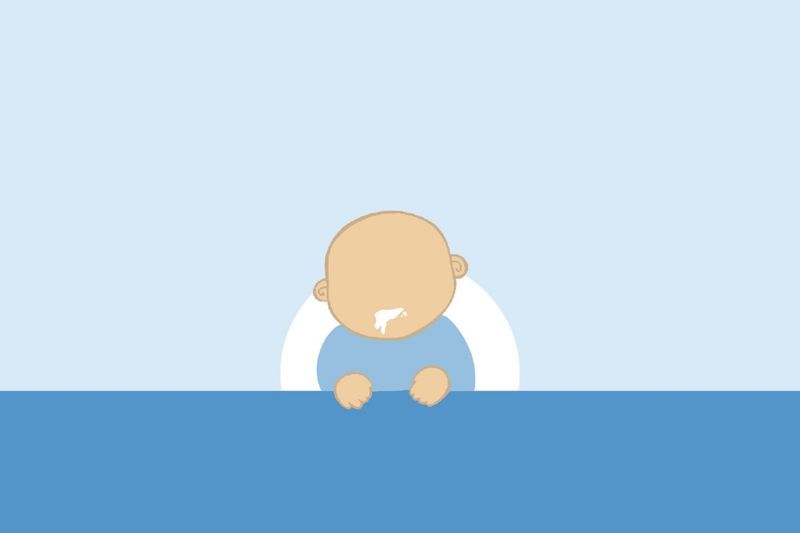
Vomiting in infants, while upsetting, is common and usually does not signal a serious illness. After all, everyone gets an upset stomach once in a while, and vomiting is a common symptom of many childhood illnesses. However, there are some cases where vomiting signals something more serious.
Vomiting should not be confused with spitting up. Most babies spit up—sometimes often—and are perfectly normal and healthy. In fact, don’t be surprised to see your baby smiling while spitting up, even if you don’t find it especially amusing. Vomiting, on the other hand, is more than just spitting up. Vomiting is when the stomach contents are forcefully ejected from the stomach through the mouth and looks and feels uncomfortable.
A newborn who vomits more than once may be developing a condition called pyloric stenosis. This occurs when the valve between the stomach and the small intestine thickens so the stomach contents are unable to leave the stomach. This results in forceful, or “projectile,” vomiting especially right after eating. If your baby vomits like this after every feeding, call your child’s doctor right away.
Infant vomiting can also be a symptom of GERD. GERD, or gastroesophageal reflux disease, in infants is suspected when a baby’s normal spitting up gets progressively worse over time. The baby may also have pain either during or after feeding and seem irritable or arch their back after feeding. Left untreated, GERD can lead to breathing problems like wheezing, as well as poor growth. If reflux is suspected, your doctor will recommend smaller, more frequent feedings, frequent burping, and keeping the baby in an upright position for at least thirty minutes after feeding. If this fails to improve the reflux, your doctor may try a medication or a change in formula.
Infections can also cause vomiting in infants. A stomach bug, ear infection, urinary tract infection, meningitis, and appendicitis can all cause vomiting. If your baby appears uncomfortable, vomits more than once or twice, or has fever, it is best to contact their pediatrician right away.
Sources:
- Neonatal Handbook
- Vomiting in the Newborn Infant.
The American Academy of Pediatrics, “The Complete and Authoritative Guide Caring for your Baby and Young Child: Birth to age 5” pp.522-524
Powered by Bundoo®
Download the Nabta App


Related Articles

Is Performing a C-Section Better Than Inducing Labour? [2024]
Is Performing a C-Section Better Than Inducing Labour, when it comes to giving birth, usually the preferred option is to let labour proceed naturally. However, there are times when it is not in the mother or baby’s interest for this to happen. When the health of either is at risk, or if gestation has exceeded [41 weeks duration,](https://nabtahealth.com/articles/doctor-tips-weeks-27-40/) then it is highly probable that an alternative strategy will need to be implemented. There are two options available, [inducing labour](../) or performing a [C-section](../). With an induction, the [uterus](https://nabtahealth.com/glossary/uterus/) is artificially stimulated to contract, and it is then hoped that labour will proceed as per a natural delivery. In contrast, a C-section is a surgical procedure, whereby a cut is made in the abdomen and the baby is removed that way, rather than via the [vagina](https://nabtahealth.com/glossary/vagina/). Sometimes the only safe option is to perform a C-section, for example if the baby is breach, or when an emergency situation arises. However, there are other times when you may be presented with a choice and if this happens, what is the correct answer? Unfortunately there is no definitive right answer. An induction can be at least as safe as spontaneous labour and, if performed in the week prior to the [due date](https://nabtahealth.com/glossary/due-date/), it is thought to reduce [the risk of](https://nabtahealth.com/articles/what-is-preeclampsia/) [preeclampsia](https://nabtahealth.com/glossary/preeclampsia/) in the mother and respiratory distress in the child, possibly as a result of the [placenta](https://nabtahealth.com/glossary/placenta/) remaining fully functional. Unlike C-sections, inductions are not surgical procedures and thus, if all goes to plan, the recovery period is shorter. It is however, a big ‘IF’. [Induced labours](https://nabtahealth.com/articles/induction-of-labour/) are typically more painful, meaning more women will request stronger pain relief including epidurals, and there is a greater likelihood of assisted delivery, such as the use of forceps or ventouse. There is also an increased [risk of hyperstimulation](https://nabtahealth.com/articles/what-is-ovarian-drilling/) of the [uterus](https://nabtahealth.com/glossary/uterus/)., Uterine hyperstimulation causes more frequent, longer [contractions](https://nabtahealth.com/glossary/contraction/), which can [lead](https://nabtahealth.com/glossary/lead/) to complications such as foetal heart rate abnormalities and, in rare cases, uterine rupture. In a significant number of women, induction does not work and a C-section becomes necessary. The advent of the C-section was undoubtedly a medical revolution, instantly saving the lives of millions of women and children. However, C-sections bring with them all the risks of regular surgery, including blood clots, wound infection and bleeding. The recovery period is typically longer after a C-section than after a natural birth, driving restrictions are enforced and a scar remains, although this will fade over time. Whilst current guidelines stipulate that an induction should only be performed when [the risks of continuing the pregnancy](https://nabtahealth.com/articles/complications-during-pregnancy-polyhydramnios/) outweighs the benefits, with more women than ever requesting elective C-sections, the World Health Organisation has highlighted an urgent need for medical assessment efforts to address the risks of induced labour compared to elective C-section. Until such work is undertaken, it becomes a matter of individual circumstance, personal choice and ultimately weighing up what is best for you and your baby. **Sources:** * Grobman, W A, et al. “Labor Induction versus Expectant Management in Low-Risk Nulliparous Women.” _The New England Journal of Medicine_, vol. 379, no. 6, 9 Aug. 2018, pp. 513–523., doi:10.1056/NEJMoa1800566. * WHO Recommendations for Induction of Labour. World Health Organisation, [http://apps.who.int/iris/bitstream/handle/10665/44531/9789241501156\_eng.pdf?sequence=1](http://apps.who.int/iris/bitstream/handle/10665/44531/9789241501156_eng.pdf?sequence=1). Accessed on 23/01/2019. * _Inducing Labour. Clinical Guideline \[CG70\]_. NICE (National Institute for Care and Health Excellence), July 2008, www.nice.org.uk/guidance/cg70/chapter/Introduction. Accessed on 23/01/2019

When can Your Child eat Sushi and raw Fish?
Sushi is considered a healthy eating option and its popularity is growing in the US. Many parents wonder if it is safe for their young child to eat sushi and when they can safely introduce it in the diet. According to the American Academy of Pediatrics (AAP), there is no need to delay the introduction of fish or shellfish beyond [4-6 months](https://nabtahealth.com/articles/when-can-your-child-eat-sushi-and-raw-fish/) of age in healthy, low food allergy risk children. Specifics about whether the fish is cooked or raw are not made, and the assumption is that this stance reflects cooked fish and shellfish. The Food and Drug Administration ([FDA](https://nabtahealth.com/glossary/fda-2/)) specifies that no raw fish or shellfish should be given to high-risk groups, highlighting very young children as one such group. At what age is a child no longer considered at high-risk? --------------------------------------------------------- A [child’s immune system](https://nabtahealth.com/articles/when-can-your-child-eat-sushi-and-raw-fish/) development is slow and steady during the first 2-3 years of life, and by age 4-6 years old, adult levels of immunity are seen. Your [child’s immune](https://nabtahealth.com/articles/can-daycare-build-your-childs-immune-system/) system continues to develop throughout [puberty](https://nabtahealth.com/glossary/puberty/). Given this information, waiting until 5-6 years of age to introduce raw fish and uncooked sushi is the best way. This will ensure your child is defended against potentially harmful substances. Bacterial contamination is a threat to any temperature sensitive food and cannot be seen, smelled or tasted. [Food poisoning](https://nabtahealth.com/articles/how-to-avoid-food-poisoning-during-pregnancy/) symptoms are similar to the stomach flu, so they may be hard to detect. Asking questions about the quality of food and how it is prepared is good. However, taking care to eat at reputable restaurants that you trust can help prevent adverse reactions to contaminated sushi. US restaurants are required to use sushi that has been properly frozen and/or cooked to eliminate parasitic contamination. ##### Food allergies The [Food Allergy](https://nabtahealth.com/articles/4-ways-to-know-if-your-child-has-a-food-allergy/) and Anaphylaxis Network states that about 7 million people in the US have a reported seafood allergy. In addition to seafood allergy risk, Asian cuisine can often contain other allergens such as peanut, egg, tree nut, and soy ingredients. Raw or cooked sushi is typically assembled into a firm, round food. Sashimi is a raw piece of fish set atop a small amount of rice; it has a slippery texture. Both sushi and sashimi may present a choking hazard, especially for young toddlers. A child to eat sushi may also have a sticky texture that may be foreign to the child. Cutting cooked sushi into small pieces before serving it to your toddler can minimize the risk of choking. When it comes to raw sushi or sashimi, it may be best to leave it out of your child’s diet as they are young and building a strong immune system. However, there is no reason why your toddler can’t safely enjoy cooked or vegetarian Asian cuisine, with special attention paid to its ingredients. If you enjoy sushi and other Asian cuisines and want to pass this along to your child, think about alternatives to raw fish such as: Vegetable rolls ##### **Those containing only cooked fish and/or shellfish** * Rice bowls * Tempura * Soups * Salads * Stir-fry * Teriyaki The truth is that while food safety, allergies, and choking hazards should always be considered. There really is no consensus on an exact age that is appropriate to give a young child raw fish. By 5-6 years old, a healthy [child’s immune system](https://nabtahealth.com/articles/can-daycare-build-your-childs-immune-system/) should be strong enough to graduate to raw sushi with the rest of the family. No magical age, grade level, or number of exposures to sushi will prevent the occurrence of an illness from contaminated food. Good judgment and necessary precautions should always be in place. **Sources:** * U.S * Food & Drug Administration * Fresh and Frozen Seafood: Selecting and Serving it Safely. KidsSafe Seafood. Food Allergy and Anaphylactic Network. Powered by Bundoo®

Is it Safe for Toddlers and Children to eat raw Oysters?
Food-borne illnesses do not discriminate — anyone can become sick. Raw oysters have earned a reputation as a potentially dangerous food. Also, some groups of people have a [greater risk of serious illness](https://nabtahealth.com/articles/is-fish-oil-safe-for-children/) than others, including children. Eating raw oysters comes with the risk of being exposed to Vibrio vulnificus, a potentially life-threatening bacteria. Young children, those under 5 years of age, are more susceptible to food-borne illness because their immunity isn’t fully developed. Here are some facts you should know before you give your young child raw oysters: ##### What will happen if my child eats a contaminated oyster? In reality, allowing your [child to eat](https://nabtahealth.com/articles/is-it-safe-for-toddlers-and-children-to-eat-raw-oysters/) raw oysters might have zero consequences, no matter how many he or she eats. Unlike other bacteria, V. vulnificus cannot be smelled, seen, or tasted. There is no way to determine if the raw oyster is safe to eat. V. vulnificus cannot be killed by a lot of hot sauce, nor are you guaranteed safety by letting your child just try one or two oysters. If your [child eats a raw oyster](https://nabtahealth.com/articles/is-it-safe-for-toddlers-and-children-to-eat-raw-oysters/) that is contaminated with V. vulnificus, it is important to be familiar with the signs and symptoms of food poisoning. In generally healthy people, V. vulnificus can cause vomiting, diarrhea, and abdominal pain. In some cases, it can become worse and infect the blood (invasive septicemia) resulting in fever, chills, and septic shock. V. vulnificus is a serious cause for concern because about half of people who contract the blood infection die. If you are suspicious of food poisoning and/or your child has symptoms, get in touch with your healthcare provider, or even head to the ER. ##### What should I do? To be safe, you may want to hold off on feeding your child raw oysters for a few years, or at least until he or she is five years of age. If oysters are a staple in your household, or a special treat here and there, make sure to thoroughly cook a few for your little one to try. Cooking (prolonged exposure to high heat) is the only way to kill the bacteria and make sure you and your family will be safe. Get yourself a [coach](https://nabtahealth.com/product/conscious-motherhood-coaching-session/) and learn more. **Sources:** * Food & Drug Administration * Raw Oyster Myths. Powered by Bundoo®